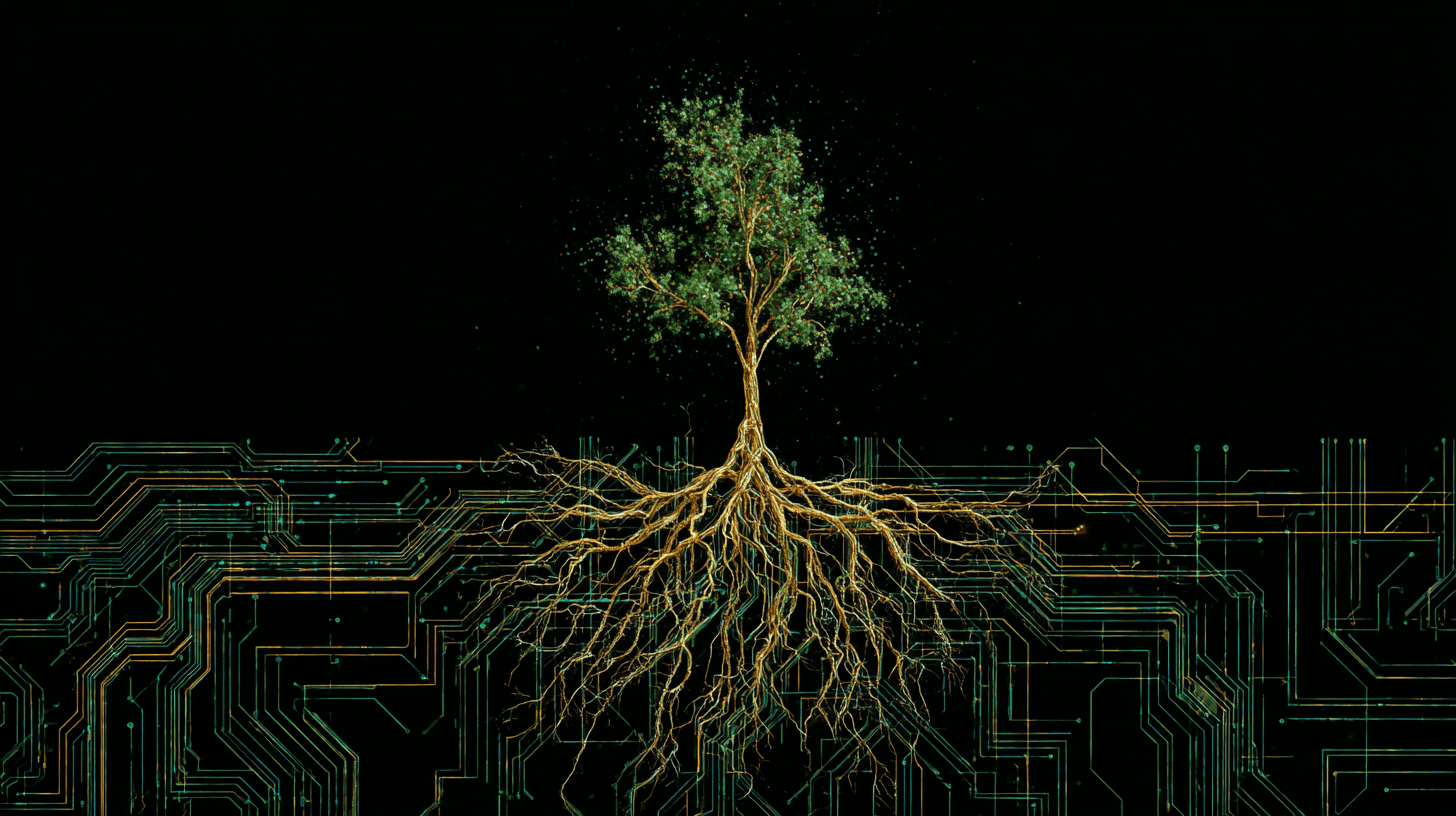

In early 2026, Cobble officially begins operations.
To many people, Cobble may appear to be another artificial intelligence infrastructure company entering a rapidly growing market. In one sense, that is true. We provide high-performance inference for open-weight language models, OCR systems, and embedding services. We help businesses, researchers, developers, and public institutions run advanced AI workloads with speed, privacy, and control.
But Cobble was founded on a different premise than most companies in this space.
We did not begin with venture capital, newly manufactured hardware, or a plan to build another centralized technology platform in Silicon Valley.
We began in scrapyards.

Seeing Value in What Others Threw Away
Before Cobble existed, the founders spent years working not only as software developers and systems architects, but also in the electronic scrap and precious metals refining industry.
That experience offered a unique perspective.
Every day, we saw an extraordinary volume of equipment entering the waste stream: servers, GPUs, solar panels, batteries, and industrial components that still possessed enormous functional value. Many had been retired not because they were unusable, but because they had been superseded by newer generations of technology.
In the refining world, value is often measured by the precious metals hidden inside discarded devices.
But another kind of value was equally apparent.
These machines still worked.
They still computed.
They still had years of useful life remaining.
And in an age increasingly defined by artificial intelligence, they represented something even more significant: latent intelligence infrastructure.
A Second Life for Supercomputer Hardware
As the AI boom accelerated, demand for GPUs intensified. Around the world, organizations were rushing to purchase newly manufactured hardware, often at enormous financial and environmental cost.
We saw a different path.
We began sourcing decommissioned and reclaimed high-performance computing equipment, including GPUs and server components from scientific and enterprise environments. These were machines built for advanced scientific workloads, engineering simulations, and large-scale computation.
Rather than allowing them to be dismantled or discarded, we refurbished and redeployed them into a new distributed inference network.
Machines that once helped model the physical world are now helping power the next generation of artificial intelligence.
Beyond GPUs: Reclaiming the Entire Stack
Our sustainability efforts extend beyond compute hardware.
We are also sourcing older-generation solar panels that remain operational but are frequently removed from service and sent toward disposal. In parallel, we are exploring ways to integrate retired electric vehicle and hybrid battery packs into modular energy storage systems.
Together, these components form the basis of a broader vision.
We believe low-cost, low-power AI infrastructure can be built from technologies that society has prematurely classified as waste.
By combining reclaimed GPUs, repurposed solar arrays, and upcycled battery systems, it becomes possible to deploy self-contained intelligence nodes at a fraction of the cost of conventional infrastructure.
These systems can be installed in rural communities, municipalities, universities, cooperatives, and research organizations across the United States and eventually throughout the world.
Local Intelligence and Data Sovereignty
Cobble is not merely about reducing waste.
It is about restoring ownership.
The modern AI landscape has become increasingly centralized. Data is transmitted to distant data centers, absorbed into opaque systems, and processed by infrastructure controlled by a small number of large corporations.
We believe there is another way.
Your data belongs to you.
Your models belong to you.
Your institutional knowledge belongs to the community that created it.
These are not optional product features. They are fundamental rights.
Cobble is designed to preserve data sovereignty by enabling inference to be served locally and regionally. Organizations can keep their information near its point of origin, maintain direct control over their intellectual property, and develop AI systems aligned with their own priorities.
We call this principle local intelligence.
Knowledge should remain close to the people and places that generate it.
The Circular Economy of Computation
The name Cobble reflects our philosophy.
To cobble something together is to build resourcefully from what is available. It is an act of practical creativity.
The word also evokes cobblestone roads: durable networks assembled piece by piece, linking towns and communities into something larger and more resilient.
That is how we think about infrastructure.
Each reclaimed GPU, each refurbished battery, each repurposed solar panel becomes part of a larger system.
Each local deployment becomes a node in a distributed network of sustainable intelligence.
Together, they form a circular economy of computation in which hardware is reused, energy is decentralized, and value remains rooted in the communities that deploy the technology.
Building Community-Scale AI
Our long-term vision is ambitious.
We want to make advanced artificial intelligence infrastructure affordable and accessible at the community level.
Imagine towns, universities, hospitals, libraries, research institutions, and municipal governments operating their own sovereign AI systems.
Imagine local models trained on local knowledge.
Imagine compute infrastructure powered partly by reclaimed hardware and renewable energy.
Imagine intelligence as a public utility rather than a distant subscription service.
Cobble exists to help make that future possible.
A Different Story About Artificial Intelligence
Much of the public conversation about AI focuses on disruption, concentration of power, and existential risk.
Those concerns deserve serious attention.
But they are not the only story.
Artificial intelligence also presents an opportunity to rethink how we build technology, how we manage resources, and how we preserve knowledge.
It offers a chance to reduce waste, extend the life of valuable materials, and provide communities with new tools for research, education, healthcare, and innovation.
Used responsibly, AI can help us design systems that are more efficient, more sustainable, and more locally accountable.
We do not believe artificial intelligence is destined to destroy the world.
We believe it may help us save it.
Launching in 2026
Throughout 2025, we devoted ourselves to building the foundation.
We developed the routing software.
We engineered the metering systems.
We assembled the infrastructure.
We tested reclaimed hardware.
We refined our sustainability model.
And we articulated a vision for a different kind of AI company.
In early 2026, that work becomes operational.
Cobble launches as a sustainable inference platform dedicated to high-performance model serving, data sovereignty, and community-scale intelligence.
Cobbling Together the Future
We are not headquartered in Palo Alto.
We are not pursuing growth at any environmental cost.
And we do not believe technological progress requires discarding everything that came before.
We believe the future can be assembled from what already exists.
From reclaimed GPUs.
From retired solar panels.
From repurposed batteries.
From local knowledge.
From practical engineering.
From communities determined to retain ownership of their own intelligence.
That is why we built Cobble.
To prove that artificial intelligence can be sustainable.
That it can be sovereign.
And that the most powerful systems of the future may be built from the materials the world almost threw away.