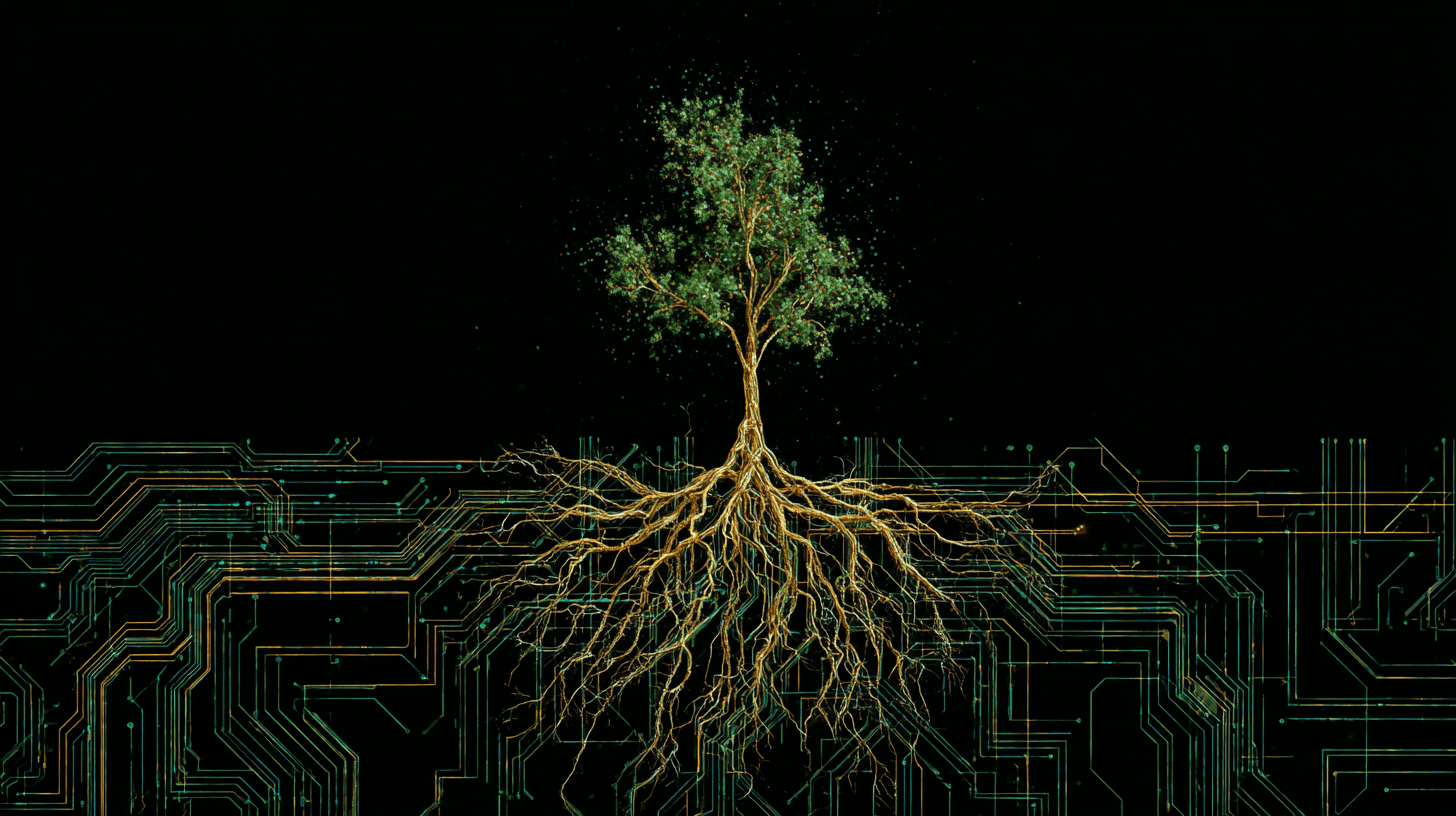

Every technology that reshapes an economy eventually faces the same question: who owns the infrastructure? Railroads, electricity, telephones, and the internet each arrived as a promise of transformation for every town they touched, and each one settled, for a time, into the hands of a few companies that decided where the lines went and what the service cost. In every case, the places that fared best were the ones that found a way to own a piece of the infrastructure themselves.
Artificial intelligence is at that moment now. It is described, accurately, as a technology that will transform local economies. Yet the infrastructure behind it is being built in a shape that leaves almost nothing in local hands: a small number of enormous facilities, owned by a small number of companies, serving everyone else from a distance. The transformation is real. The ownership is not.
The Serve Local Movement is Cobble's answer to that. This article is about what it is, where the idea comes from, and why we believe it describes a better future.
What Serve Local means
Serve Local is a simple proposition. Inference, the part of AI that people and applications actually use, should be served from installations that are physically near the communities using it, owned by organizations that belong to those communities, running efficiently on resources those communities already have.
Each of those three clauses matters.
Near. Lower latency, regional resilience, and data that stays within the jurisdiction it came from. An inference installation sized in kilowatts rather than megawatts can live in a town, not just in a tax-advantaged exurb with a new substation.
Owned locally. A municipal utility, a cooperative, a university, a regional company. The revenue stays. The skills stay. The decisions about what to run, whom to serve, and how to price it are made by people who live with the consequences.
Efficient on what exists. Reclaimed hardware instead of new. Existing electrical service, rooftop solar, and local generation instead of a new power plant. Software engineered to run older accelerators at high utilization, so that the energy per request is a fraction of the industry norm. Cobble has already shown this works: the network runs on reclaimed equipment across three sites, with a measured solar share of completion power and no evaporative cooling, and a completion uses roughly a third of the energy of a typical industry equivalent.
Serve Local is not a rejection of large-scale computing. Training frontier models will continue to require facilities of enormous scale, and that is fine. It is a claim about inference specifically: that the most-used layer of AI does not need to be centralized, and that the places where it is used are better off when it is not.
Three precedents
This idea is not new. It has played out three times already in living memory, and each time the lesson was the same.
Distributed energy generation. For most of the twentieth century, electricity meant a central plant and a one-way grid. Then solar panels became cheap enough to put on a roof, and the model changed. Homes, farms, schools, and businesses became generators as well as consumers. The grid did not disappear; it became a network that moved power in every direction, and the communities that invested in local generation gained resilience, lower costs, and a share of the value they had previously only paid for. The central plants are still there. They are no longer the only option.
Community broadband. When national carriers decided that rural and small-town America was not worth wiring, hundreds of communities built their own networks: municipal fiber, electric cooperative broadband, public-private partnerships. The incumbents said it could not be done at that scale and fought it in legislatures. The communities did it anyway, and many of them now have faster, cheaper service than the cities the carriers chose to serve first. The lesson was that the infrastructure of a critical utility can be owned by the people who depend on it, and that they will often run it better.
The early internet. The internet was designed as a network of networks, with no center, where any organization that could run a server could participate on equal terms. That design produced an explosion of participation that no central operator could have planned. Much of it has since consolidated into a handful of platforms, but the architecture is still there underneath, still proving that a decentralized system can be both robust and generative in ways a centralized one cannot.
AI inference is the next instance of this pattern. The centralizing phase is happening now. Serve Local is the distributed phase, and the precedents suggest it is not only possible but likely to be where the durable value ends up.
Why now
Three things have converged to make this practical rather than aspirational.
First, open-weight models. A community cannot serve a model it is not allowed to run. The rise of capable open-weight models means that an installation anywhere can serve inference that is competitive with proprietary offerings, without permission from anyone.
Second, reclaimed hardware. The supply of retired, highly capable accelerators from research clusters, commercial leases, and the supercomputing ecosystem around Oak Ridge, Tennessee is large and growing, and the price is a fraction of new. A community installation does not have to compete with hyperscalers for the newest silicon. It can run on what they have already discarded, and run it well.
Third, the serving stack. The hard engineering, routing requests across sites and pools, queueing under load, refusing cleanly when full, metering usage, enforcing budgets, measuring energy, is now in production on the Cobble Network. It does not have to be rebuilt by every operator. It can be the shared foundation on which local installations are built, so that a community's effort goes into hardware, power, and people rather than into reinventing a relay.
What it looks like in practice
Cobble is in active discussions with communities in Western Kentucky and Eastern Kentucky about building municipal inference infrastructure. These are regions with industrial electrical capacity that is underused, with workforces whose skills transfer directly to running physical infrastructure, and with a long memory of what it means to host an industry that extracts value and leaves. The proposition is different this time: an installation the community owns, serving its own schools, hospitals, businesses, and residents, connected to the Cobble Network so that its capacity can also serve the wider network and earn for the community that runs it.
This is the model. Not a data center that lands in a county and hires a dozen people. A piece of critical infrastructure that the county operates, the way it might operate a water plant or a fiber network, and that pays its way.
A more accessible resource
Cobble's mission is to make computational intelligence a more accessible and locally sustainable resource. Accessible means that a developer anywhere can use capable open-weight models at honest prices, with transparent limits and measured environmental cost. Locally sustainable means that the infrastructure serving them runs on reclaimed hardware and local energy, in places that own it and benefit from it.
Those two goals are the same goal. A network of locally owned, efficiently run installations is both the most sustainable way to serve inference and the most accessible, because it puts capacity, revenue, and decision-making in more hands rather than fewer.
The future of AI does not have to be a few buildings serving the world. It can be a network of communities serving themselves and each other. That is the Serve Local Movement, and it is what Cobble is building.
The Cobble Team